
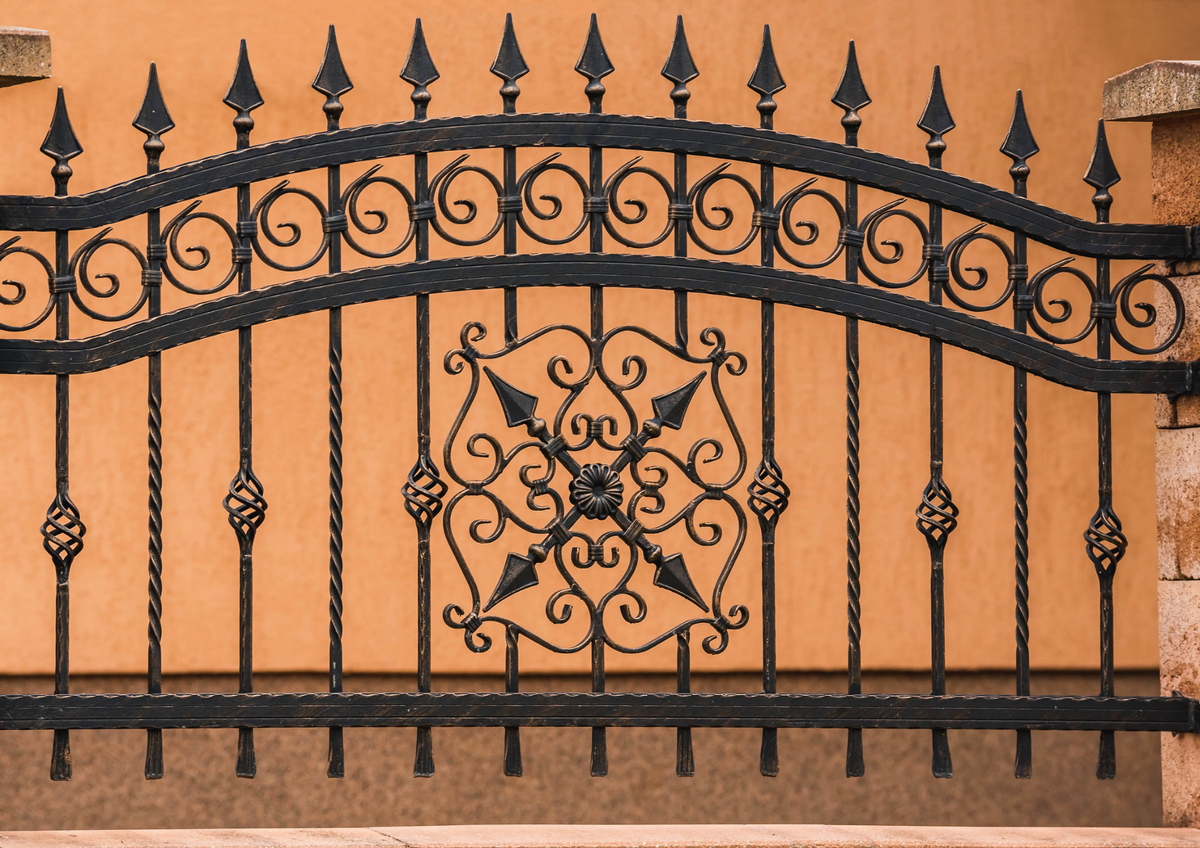
Ironwork in Chicago is expected to rust eventually. When it rusts in two or three years, something was done wrong before it ever met weather. Premature rust is almost never a story about the climate. It is a story about what was under the coating, or what the coating was applied over, or the conditions the day it went on.
Short answer: Premature rust traces back to seven preventable failures, and all of them happen at fabrication or coating rather than in service: mill scale left on the steel, hand-tool prep where blasting was required, a blast profile that is too shallow or too aggressive, soluble salts left on the surface before recoating, flash rust coated over after blasting, coating applied within 5 degrees of the dew point, and galvanizing damaged after fabrication and never repaired. None of these are visible once the finish coat is on, which is why the problem appears later as a surprise.
Why Premature Is the Right Word
Corrosion on exposed steel is normal and slow when the protection is sound. The accelerants in this climate are real, but they explain the pace of normal corrosion rather than a coating that fails in its second winter.
A fence that rusts early is almost always a case of a coating that never bonded properly, or one that was applied over something it could not bond to. The useful distinction is that weather is the test, not the cause. Everything below is a reason the ironwork failed the test.
7 Causes of Premature Rust
1. Mill scale left on the steel. Mill scale is the heavy bluish oxide layer that forms on steel during hot fabrication. Coating over it is the single most consequential shortcut available, for two reasons. The scale eventually breaks loose and takes the coating with it. And steel is anodic to mill scale, meaning the steel corrodes preferentially in order to protect the scale sitting on top of it. The substrate is actively sacrificing itself under an intact-looking finish.
2. Hand-tool prep where blasting was required. Wire brushing and power tool cleaning remove loose material. They do not remove tight mill scale or produce the surface a high-performance coating needs. The standards distinguish these deliberately: hand and power tool cleaning sit well below commercial blast cleaning and near-white blast cleaning in what they actually achieve. A repaint done with a wire brush on steel that needed blasting is a coating with a service life measured in seasons.
3. A blast profile that is wrong in either direction. Blasting is not just cleaning, it creates the anchor pattern the coating grips. Too little pressure gives a shallow profile and poor adhesion. Too much is also a failure: excessive pressure leaves profile peaks standing above the prime coat, and those uncoated peaks become pinhole failures. Blast pressure in the range of 90 to 100 psi is the working target, and the abrasive itself determines the profile.
4. Soluble salts left on the surface. The one most specific to Chicago. Chloride from de-icing salt deposits on steel and does not come off with abrasive cleaning alone, so it survives blasting and sits under the new coating. Salts draw moisture through the film by osmosis, producing blistering and accelerating corrosion underneath it. Chloride is the most aggressive of them. This is why a repaint on a fence that has taken years of road salt needs washing before preparation, not just blasting, and why contaminated abrasive is its own hazard: blast media is held to a conductivity limit precisely because dirty media introduces the problem it was meant to remove.
5. Flash rust coated over. Freshly blasted steel is chemically bare and starts to rust within hours in humid conditions. Blast on Friday, prime on Monday, and the primer goes over a thin film of new rust. The standards allow reblasting specifically to remove flash rust, which tells you it has to come off rather than be painted over. The practical rule is that blasting and priming belong in the same working window.
6. Coating applied within 5 degrees of the dew point. The requirement is that the steel surface sit at least 5 degrees Fahrenheit above the dew point, both before surface preparation and during application. Below that margin, invisible condensation forms on the surface and the coating is applied over a film of moisture. In practice this is a scheduling failure rather than a knowledge failure. A cool morning in spring or fall on a shaded north elevation can put steel below the margin while the air temperature looks perfectly reasonable, which is why a thermometer and a dew point reading matter more than the forecast.
7. Galvanizing damaged after fabrication and never repaired. Welding, cutting and drilling after galvanizing all remove zinc. The coating does protect small bare spots sacrificially, so a scratch is not an emergency, but field work that removes coating should be minimized and bare areas should be repaired rather than left. Repair methods are zinc-based solder, zinc-rich paint, or zinc spray metallizing, and the repaired area needs to deliver at least 2.0 mils in one application. A galvanized rail with an unrepaired field cut or a drilled hole has a defect exactly where water will sit.
What All Seven Have in Common
Two things, and they explain why this problem is so persistent.
Every one of them is decided before the ironwork is installed. By the time a fence is in the ground, the mill scale question, the preparation question, the dew point question and the galvanizing repair question are all already answered. Nothing done afterward changes them.
And every one of them is invisible on delivery. A fence with mill scale under the primer and a fence prepared properly look identical on day one, and both look fine for a year. The difference shows up in year two or three, which is long enough that it gets attributed to weather rather than to workmanship.
That is the argument for treating metal painting as a specification rather than a line item. Preparation is most of the cost and all of the service life, and it is the part that cannot be inspected once the finish coat is on.
Key Takeaways
Premature rust is a coating or preparation failure, not a climate problem. Weather is the test rather than the cause.
Steel is anodic to mill scale, so steel under scale corrodes to protect the scale while the finish still looks intact.
Wire brushing does not remove tight mill scale and does not substitute for blasting on a surface that needs it.
Blast profile fails in both directions: too shallow gives poor adhesion, too aggressive leaves peaks above the primer that become pinholes.
Soluble chloride salts survive abrasive cleaning, draw moisture through the film osmotically and blister the coating from beneath.
Blasted steel flash rusts within hours, and flash rust has to be removed rather than primed over.
Surface temperature must be at least 5 degrees Fahrenheit above the dew point before preparation and during application.
Galvanizing removed by welding, cutting or drilling should be repaired to at least 2.0 mils using zinc solder, zinc-rich paint or zinc metallizing.
Frequently Asked Questions
My fence is only three years old and already rusting. Is that normal?
No. Sound protection on exposed steel lasts far longer than that in this climate, so rust at three years points to preparation or application rather than exposure. The usual findings are mill scale left under the coating, inadequate preparation on a repaint, or salt contamination that was never washed off. Worth having assessed before recoating, because recoating over the same underlying problem produces the same result.
Can I just sand and repaint it myself?
You can, and on genuinely light surface rust over sound metal that is a reasonable approach. The limitation is that hand and power tools will not remove tight mill scale or soluble salt contamination, which are the two most common underlying causes. If the coating is failing in sheets, or failing again in the same spots after a previous repaint, the preparation standard is the issue rather than the paint.
Why does the same spot keep rusting after being repainted?
Because the cause is under the coating rather than on it. A recurring failure in a consistent location usually means mill scale, retained salts, or a profile problem at that spot, none of which are addressed by applying more paint. The fix is preparation back to sound, clean, properly profiled steel before anything is applied.
Does weather on the day really matter that much?
Yes, and the dew point margin is the part most often ignored. If the steel is within 5 degrees Fahrenheit of the dew point, there is condensation on the surface whether or not it is visible, and the coating is being applied over water. Air temperature can look fine while shaded steel sits below the margin, which is why surface temperature gets measured rather than assumed.
Is galvanized ironwork immune to this?
Not immune, but far more forgiving, since zinc protects the steel sacrificially rather than only as a barrier. The failure mode shifts to places where the zinc was removed after galvanizing: field cuts, welds and drilled holes. Those are the locations to inspect on otherwise well-protected work, and repairing them is straightforward if it happens rather than being skipped.
Preventing Premature Rust on Chicago Ironwork
The pattern behind premature rust is that all of it is decided early and none of it is visible late. Mill scale, preparation standard, profile, contamination, flash rust, dew point and galvanizing repair are settled at the shop and on the day of application, and the ironwork then spends two or three years looking fine before reporting the result.
Americana Iron Works fabricates, refinishes and repairs iron fencing, railings and custom ironwork across Chicago, including metal fence painting and railing refinishing where preparation is the actual scope of work. If a coating is failing early or failing repeatedly in the same places, that is worth diagnosing before another coat goes on. Request a quote with photographs of how the coating is failing rather than just the overall fence, since the failure pattern indicates the cause.