
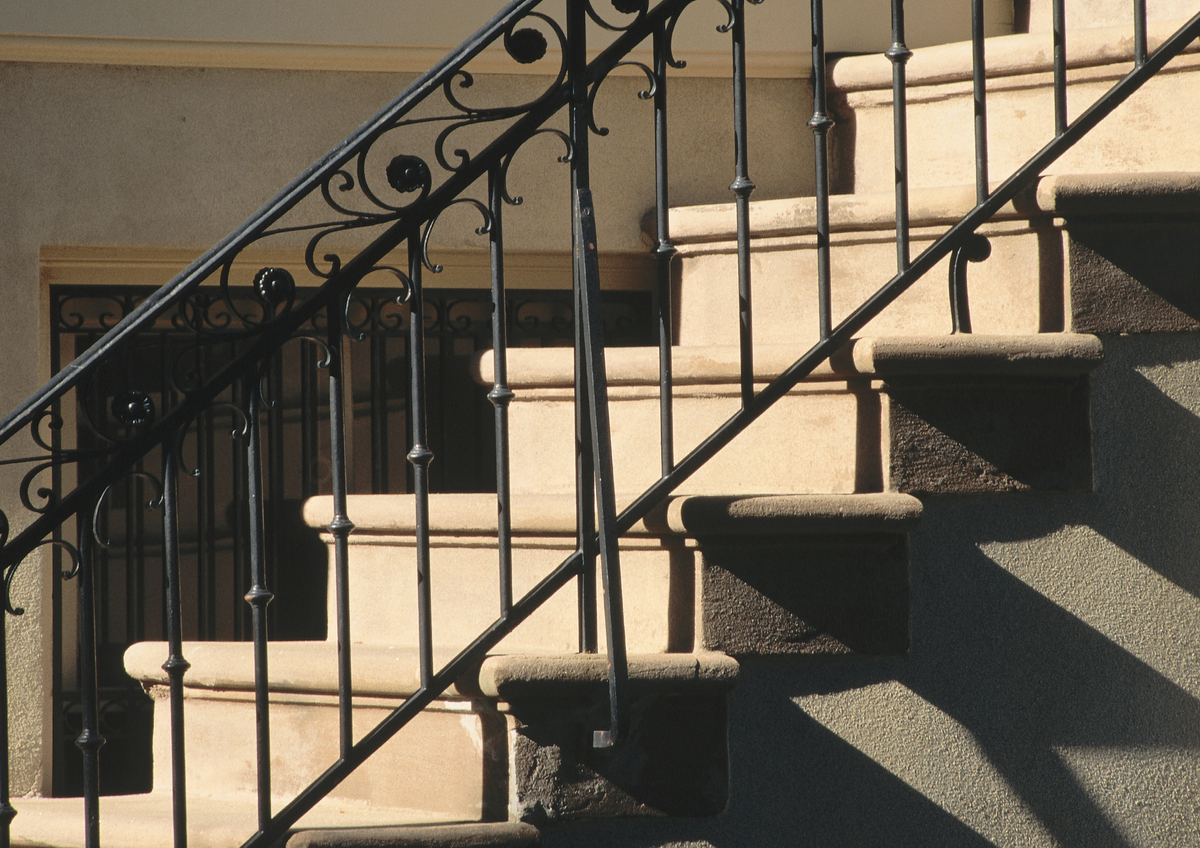
An iron railing has one job, and nobody thinks about it until the moment it matters. Somebody loses their footing on a wet stair, puts their weight against the rail, and it either holds or it does not. A railing rarely announces its condition, and it looks the same the week before it fails as it did five years earlier. Most of what follows takes about ten minutes to check, and most of what turns up is repairable long before railing replacement is the only option.
SHORT ANSWER
Check for movement first. A railing that shifts, wobbles, or rocks when you push on it has lost its connection to the structure, and that is the most urgent finding. Then look at the base of each post where it meets concrete, at the welds where pickets meet rails, and at any point where the railing attaches to the building. Corrosion at the base, cracked concrete around the anchors, broken welds, and separation from the structure all mean the railing should not be relied on until it has been repaired.
How to Check a Railing Without Damaging It
Stand on stable ground, not on the stair or balcony you are testing. Put a firm hand on the top rail and push horizontally, the way a person falling against it would load it. You are not trying to break anything. You are checking whether it moves.
Work along the railing post by post rather than pushing only in the middle, since a single failed anchor can hide between two sound ones. Do the same for the pickets, then look closely at the base of every post.
Do this in spring. Winter is what damages iron railings in Chicago, and spring is when you find out what it did.
The Seven Signs an Iron Railing Is Failing
1. It moves when you push on it
Any movement is a problem. A railing should feel like part of the building, not like a piece of furniture sitting against it. Wobble, rock, or shift at the base means the connection between the railing and the structure has failed or is failing, and the fasteners or the anchor point are no longer doing their job.
This is the single most serious finding on the list, because it means the railing will not resist the load it exists to resist. Stop using the area if the movement is significant.
2. Corrosion at the base of the posts
Look where each post meets concrete or the stair tread. This is where railings die.
Water collects at that junction and road salt concentrates there. A post can look sound at eye level while having lost most of its wall thickness two inches above the concrete. Flaking layered rust, pitting, or a post that has visibly narrowed at the base all mean the structural section is going.
If you can flex the post by hand at the base, or if a screwdriver pushes into the metal, the section loss is already advanced.
3. Cracked or spalling concrete around the anchors
This one gets misread as a concrete problem. It is usually a steel problem.
When steel corrodes, the rust that forms occupies considerably more volume than the original metal. Steel embedded in or anchored to concrete expands as it rusts, and that expansion cracks the surrounding concrete from within. Cracks radiating out from a post base, or concrete flaking away around it, generally mean the embedded steel is corroding and forcing the concrete apart.
Patching the concrete without addressing the steel underneath is temporary by definition, because the thing causing the crack is still there and still growing.
4. Cracked or broken welds
Look at every joint: picket to rail, rail to post, and post to base plate. You are looking for hairline cracks, rust weeping from a joint, or a visible gap where two pieces used to be joined.
Rust staining running down from a joint deserves attention even when the joint looks intact, because corrosion often starts inside the connection where you cannot see it. Broken welds concentrate load onto the remaining connections, which is how one failure becomes several.
5. Loose, missing, or bent pickets
Pickets are not decorative. They stop people, and particularly small people, from going through the railing.
A missing picket leaves a gap. A loose one indicates the weld or fastener holding it has failed. Bent pickets usually mean something struck the railing, and impact damage often extends beyond what is visible, having transferred load into the posts and welds around it.
6. The railing is pulling away from the structure
Where a railing attaches to a wall, a stair stringer, or a porch frame, check whether a gap has opened at the connection. Measure it, and look again in a few weeks.
A widening gap means active movement, and it may be in the railing, in the structure, or both. On stairs this often accompanies problems in the stringers, so stair railing issues are worth assessing alongside the stair structure.
7. Coating failure with bare metal showing
This is the earliest sign on the list and the cheapest to act on.
Paint that is blistering, flaking, or peeling has stopped protecting the steel underneath, and in a Chicago winter bare steel begins corroding almost immediately. Failed coating is not yet a safety problem. It is the condition that becomes every other item on this list if it is left alone, which is why repainting iron railings before rust penetrates is the least expensive maintenance available on ironwork.
Height and Spacing Are a Separate Question
A railing can be structurally sound and still not meet current requirements, which is a different problem with a different answer.
Guards are generally required where a walking surface sits more than thirty inches above the surface below, and both required height and the maximum opening between pickets depend on which code applies to the work and when the railing was installed. Older railings sometimes have wider picket spacing than would be permitted for new work today.
That does not automatically make an existing railing illegal, since existing construction and new work are treated differently. It matters if you are replacing the railing, if you have small children, or if the property is being sold. Confirm what applies to your building rather than assuming.
What Needs Attention Now and What Can Wait
Address immediately: any movement in the railing, a post you can flex by hand, visible section loss at a base, broken welds at post connections, or a widening gap where the railing meets the structure. Keep people off the area until it is repaired.
Schedule soon: cracked concrete at anchors, rust staining from joints, loose or missing pickets, and corrosion that has begun but has not yet caused section loss.
Plan for the season: coating failure, surface rust without pitting, and cosmetic damage.
Repair or Replace
Most railing problems are repairable, and repair is usually the better answer.
Corroded post bases can be cut out and new material welded in. Broken welds can be ground back and rewelded. Pickets can be replaced individually and anchors reset. None of that requires removing the railing, and on older properties with ornamental patterns no current catalog reproduces, repair preserves what replacement would lose.
Replacement makes more sense when corrosion is general rather than local, when section loss appears throughout the run rather than at specific points, or when the railing needs to meet current requirements anyway. Buildings with rear egress steel should assess it all at once, since fire escape railings sit in the same weather and usually share the same history.
Key Takeaways
Movement is the most urgent sign. A sound railing does not shift when you push on it.
Post bases fail first, because water and road salt concentrate where the post meets concrete.
Cracked concrete around anchors is usually corroding steel expanding, not a concrete defect.
Rust staining from a joint can indicate corrosion inside a connection you cannot see.
A widening gap between railing and structure means active movement and needs measuring over time.
Coating failure is the cheapest problem to fix and becomes the expensive ones if ignored.
Height and picket spacing are compliance questions, separate from structural condition.
Frequently Asked Questions
How much movement in a railing is acceptable?
None that you can feel. A railing should not shift, rock, or wobble under hand pressure. Any detectable movement means the connection is compromised and should be assessed.
Can a rusted railing post be repaired, or does the whole railing need replacing?
Usually repaired. If corrosion is concentrated at the base and the material above is sound, the affected section can be cut out and new material welded in without removing the railing.
Why is the concrete cracking around my railing posts?
Most often because the steel at or below the surface is corroding. Rust takes up more space than the steel it came from, and that expansion splits the surrounding concrete. Repairing the concrete alone will not stop it.
How often should iron railings be inspected?
Annually, ideally in spring after the freeze and salt season. Also check after any impact, after work on the adjacent structure, and before a property sale or inspection.
Does peeling paint mean my railing is unsafe?
Not by itself. It means the steel underneath has lost its protection and will begin corroding, which eventually becomes a structural issue. Addressing it at the coating stage is far less involved than addressing it later.
My railing looks fine but the building is old. Should I still have it checked?
Yes. The most common failure point is the base of the posts, where corrosion is often hidden by the concrete line and by paint. Age plus Chicago winters is reason enough for a look.
Conclusion
Iron railings fail quietly, at the bottom, where nobody is looking. Ten minutes with a hand on the rail and a close look at every post base will tell you most of what you need to know, and nearly everything that turns up is repairable if it is caught before the section is gone. Movement is the one that should never wait.
Americana Iron Works & Fence repairs, fabricates, and refinishes iron railings, balconies, stairs, and structural ironwork for residential and commercial properties throughout Chicago and the surrounding suburbs, with more than thirty years of in-house fabrication behind the work. If a railing on your property has started to move or the post bases are showing rust, reach out today to request a free quote.