
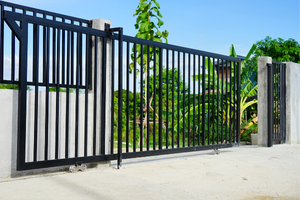
A driveway gate does more than mark the boundary of your property. It shapes how your home looks from the street, how safe it feels, and how much friction gets added to your daily routine. Get it right and it becomes invisible in the best possible way. Get it wrong and it becomes an expensive inconvenience you live with every day.
Chicago homeowners face a specific set of considerations here. Older neighborhoods like Lincoln Park, Bucktown, and Wicker Park tend to have narrower lot widths, uneven terrain, and architectural styles that demand something more considered than a standard off-the-shelf gate. Then there's the weather. Chicago winters are not kind to mechanical systems, and any gate that sits outside year-round needs to be built for that reality.
So, automatic or manual? The honest answer is: it depends on how you use your property. This guide walks through the real trade-offs.
What Separates Automatic Gates from Manual Ones
At the most basic level, the difference is simple. A manual gate is opened and closed by hand. An automatic gate uses a motorised operator, either hardwired or solar-powered, to move the gate on command, typically via a remote, keypad, or smartphone app.
But that surface-level distinction creates a cascade of other differences: installation complexity, cost, maintenance requirements, reliability in cold weather, and how well the gate integrates with the rest of your property's security setup.
Neither option is universally better. Both are used across Chicago every day for good reason.
The Case for Automatic Driveway Gates
Convenience That Compounds Over Time
If you're pulling in and out of your driveway multiple times a day, the convenience of an automatic gate stops feeling like a luxury fairly quickly. You pull up, press a button, and the gate opens. No getting out of the car. No fumbling with a latch in January when the temperature is in the single digits.
For families with multiple drivers, frequent deliveries, or properties with regular visitor traffic, that convenience adds up.
Enhanced Security Control
Automatic gates integrate naturally with access control systems. You can add a keypad entry for regular visitors, a video intercom for guests you don't recognise, or a system that logs who enters and when. For landlords managing multi-unit buildings or homeowners with home offices, this level of control matters.
Some Chicago homeowners also tie their gate into their broader smart home setup, linking it to cameras and lighting for a more complete security system.
Property Value and Curb Appeal
A well-designed automatic gate, especially one built from wrought iron or steel, tends to signal something to buyers and neighbours alike. According to a widely cited estimate from the American Society of Home Appraisers, the right gate and fencing combination can add meaningful value to a residential property, particularly in urban neighbourhoods where outdoor space is already at a premium.
Pairing a gate with a wrought iron fence installation is one of the most durable ways to achieve that kerb appeal, and in Chicago's older neighbourhoods, it tends to fit the architectural character far better than vinyl or aluminium alternatives.
What to Watch Out For
Automatic gates have moving parts, and moving parts fail. In Chicago, that's worth taking seriously. Freeze-thaw cycles, road salt carried in on tyres, and sustained sub-zero temperatures can stress gate operators, particularly cheaper units not rated for extreme cold.
Proper installation matters here. A gate that isn't balanced correctly or isn't set on a solid foundation will wear its motor out faster and become a problem within a few years. That's not an argument against automatic gates, it's an argument for getting the installation done right the first time.
The Case for Manual Driveway Gates
Lower Upfront and Long-Term Costs
There's no motor, no wiring, no operator box to maintain or replace. A manual gate is structurally simpler, which means fewer things that can break. For homeowners on a fixed budget, or those who don't use their driveway frequently enough to justify the cost of automation, a manual gate is a completely sensible choice.
It also tends to be easier to repair. If a hinge rusts or a latch wears out, fixing it is straightforward compared to diagnosing a fault in an automated system.
Simplicity on Historic or Smaller Properties
In some of Chicago's more tightly built neighbourhoods, the space simply doesn't lend itself to a swing gate with a full automation arc. Manual gates can be designed to work in tighter footprints, and they're common on smaller residential lots where a swing or sliding mechanism would be impractical to automate anyway.
For decorative gates, garden entrances, or side gates rather than primary vehicle access, manual operation is usually the right fit. There's no need to automate a gate you open twice a week.
Aesthetic Flexibility
Manual gates can be every bit as beautiful as automatic ones. Custom ironwork gates with scrolls, finials, or period-appropriate details are often hand-operated, and they look exactly right on certain types of Chicago properties. The absence of an operator box and visible hardware keeps the design clean.
Key Factors to Work Through Before Deciding
How Often Are You Actually Using It?
Be honest about this. If you park on the street or only use your garage a few times a week, full automation is probably overkill. But if you're in and out of that driveway daily, the convenience of automation pays for itself in reduced frustration alone.
Swing or Slide: Gate Type Affects Everything
Swing gates open inward or outward like a door, either as a single panel or a double. They require clear space on one side to operate. Sliding gates run along a track parallel to the fence line and suit properties where space in front of the gate is limited.
Both types can be automated or manual, but the mechanics differ significantly. A sliding gate typically requires a more substantial motor and a clean, level track. A swing gate needs enough clearance to open fully without hitting a vehicle, a wall, or a slope in the driveway.
Chicago's Permit and Code Requirements
Depending on the size of your gate, its proximity to a public way, and whether it's part of a fence over a certain height, Chicago's municipal code may require a permit before installation. This is worth confirming early, not after the work is done.
Working with a contractor who understands local code requirements from the outset will save a significant amount of time. When exploring professional gate installation, ask specifically about permit requirements for your property type and neighbourhood.
Material Choice and Chicago Weather
Wrought iron and steel are the most popular materials for driveway gates in Chicago, and for good reason. They handle the weather, resist impact, and can be fabricated to almost any design. Aluminium is a lighter alternative that won't rust, but it doesn't carry the same structural presence.
Whatever material you choose, quality of fabrication and finish matters. Properly primed and painted ironwork will last decades. Poorly finished iron starts showing problems within a few years, particularly in Chicago where road salt gets tracked everywhere.
Key Takeaways
Automatic gates are the stronger choice for properties with daily vehicle use, multiple residents, or integrated security needs. Manual gates make more sense for lower-traffic access points, smaller lots, or budget-conscious projects.
Chicago's climate demands weather-rated components. Don't assume a standard gate operator will handle a real Chicago winter.
Gate type (swing vs slide) affects cost and feasibility just as much as manual vs automatic. Map out your available space before making any decisions.
Local permit requirements are real and property-specific. Confirm what applies to your address before committing to a design.
Material and finish quality determine how long your gate looks good and functions properly. In a city with Chicago's weather, cutting corners on either will cost more in the long run.
Frequently Asked Questions
How much does automatic gate installation typically cost compared to manual? Automatic gate installation generally runs higher due to the cost of the operator, wiring, and any access control hardware. The gap varies considerably depending on gate size, material, and system complexity. Simple single-swing automatic setups are more affordable than large sliding gates with intercom and camera integration. Manual installations remove the operator cost entirely but still vary based on size and material.
Can an existing manual gate be converted to automatic? In many cases, yes. If the existing gate is structurally sound and properly hung, a motor operator can often be added without replacing the gate itself. The condition of the hinges, posts, and overall alignment will determine whether conversion is straightforward or requires additional structural work first.
What happens to an automatic gate during a power outage? Most gate operators include a manual release mechanism that allows the gate to be opened by hand when power is out. Battery backup systems are also available and worth considering for Chicago properties where winter storms occasionally disrupt power. It's something to discuss with your installer before the job is done, not after.
Are there restrictions on gate height or design in Chicago? Chicago's zoning and building code includes regulations on fence and gate height depending on location on the lot, zoning district, and proximity to public streets or alleys. Requirements vary by neighbourhood and property type. A licensed contractor familiar with Chicago's permitting process is the most reliable source for property-specific guidance.
How long does a wrought iron driveway gate typically last? A well-fabricated wrought iron gate, properly primed, painted, and maintained, can last 30 to 50 years or longer. The main maintenance requirement is periodic repainting to prevent surface rust, particularly at joints and ground-level contact points. Neglecting this for extended periods is the most common reason iron gates deteriorate prematurely.
Closing Thoughts
The manual vs automatic decision is rarely as simple as it looks on paper. Usage patterns, property layout, local code, and what you want the gate to do for your security and kerb appeal all feed into the right answer for your specific situation.
Chicago properties tend to have their own quirks, whether that's an older building with a narrow lot, a greystone facade that deserves something built to match, or a commercial property that needs controlled access around the clock. Taking the time to think through these details before committing to a design makes the difference between a gate that works well for decades and one that causes headaches from year one.
If you're working through the options, starting with a professional assessment of your property's layout and access needs is usually the most productive first step.