
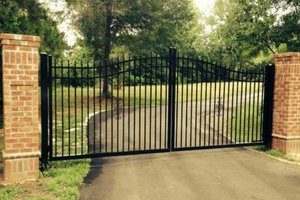
Chicago's architecture has a way of raising the stakes. A greystone in Lincoln Park, a vintage two-flat in Wicker Park, a commercial courtyard in the West Loop — these properties carry a visual weight that cheap, off-the-shelf gates simply cannot match. For property owners who care about curb appeal, security, and long-term value, wrought iron remains the material of choice. It has been used on Chicago properties for well over a century, and it still outperforms nearly every alternative when properly fabricated and installed.
But installation is where many projects go sideways. The gate itself can be beautifully designed, and the outcome can still disappoint if the groundwork, hardware, and structural considerations are not handled correctly from the start.
Why Wrought Iron Still Dominates for Gates in Chicago
Aluminum and vinyl have made inroads in the fencing world, but for gates specifically especially entry, driveway, and courtyard applications — wrought iron continues to hold a strong position. There are practical reasons for that.
Wrought iron is dense and rigid. A driveway gate needs to handle daily mechanical stress, wind load, and the occasional bump from a vehicle. Lightweight aluminum can flex and warp over time under those conditions. Wrought iron, when properly welded and finished, holds its shape for decades.
Aesthetically, it integrates with Chicago's older building stock in a way that modern materials do not. The city's building permit records show a significant concentration of structures built between 1890 and 1940, particularly in neighborhoods like Bridgeport, Beverly, Hyde Park, and Pilsen. These homes and buildings were designed with heavy masonry and ornate detailing. A wrought iron gate reinforces that visual language rather than fighting against it.
From a security standpoint, iron gates are a genuine deterrent. The International Association of Certified Home Inspectors notes that visible physical barriers significantly reduce opportunistic entry attempts. A solid, well-hung iron gate signals that a property is maintained and protected.
Types of Wrought Iron Gates and Where They Work Best
Not every gate serves the same purpose, and understanding the differences matters before committing to an installation.
Swing Gates for Residential Entry
Single and double swing gates are the most common choice for residential front entries. They work well on properties with enough clearance on either side to allow the gate to arc fully open. In Chicago's denser neighborhoods, that clearance is not always available, so site measurement is critical before any design work begins.
Double swing gates create a symmetrical, formal appearance that works especially well on greystone and brick two-flat entries. A single swing gate is a cleaner solution for tighter openings, particularly on bungalows and smaller coach houses.
Sliding Gates for Driveways
When a driveway is long enough and the property layout allows it, a sliding gate is often a better mechanical choice than a swing gate. Sliding gates require a track along the ground and a post system that can handle the full weight of the panel in motion.
In Chicago, sliding driveway gates are common on larger residential lots and commercial properties. They can be motorised with ease and work particularly well in alley-access configurations, which are a defining feature of Chicago's residential grid.
Courtyard and Garden Gates
Courtyard gates tend to be smaller in scale but often more ornate in design. These gates define the boundary between a semi-private outdoor space and the street or sidewalk, and they carry significant aesthetic responsibility.
In neighborhoods like Old Town, Roscoe Village, and parts of Evanston, courtyard gates are often paired with matching wrought iron fencing and ornamental railing systems, creating a cohesive perimeter. Getting that design continuity right requires either working with a contractor who offers full fabrication in-house or having every component sourced and specified together.
What Custom Fabrication Actually Means (and Why It Matters)
The term "custom" gets used loosely. In the gate industry, it should mean that the gate is built specifically for the opening, the architectural context, and the functional requirements of the property.
A truly custom wrought iron gate starts with accurate field measurements. Chicago's older properties often have uneven ground, non-standard opening widths, or existing masonry that dictates how posts can be anchored. A gate fabricated to a generic size and then forced to fit rarely performs well long-term. The hinges stress unevenly, the latch alignment drifts, and gaps appear that undermine both security and appearance.
Good fabricators work from those field measurements to produce a gate panel that fits the actual opening, not an approximation of it. Ornamental details, bar spacing, scroll patterns, and finial styles can all be adjusted to match the property's existing ironwork or architectural character. That level of detail matters most on high-visibility applications like front entry gates and courtyard gates facing a public street.
For property owners researching wrought iron gate installation in Chicago, it is worth asking upfront whether the contractor fabricates in-house or outsources production, because the answer has real implications for fit, timeline, and accountability.
Hardware, Automation, and Long-Term Maintenance
Gate hardware is not a detail. It is a structural component.
Hinges need to be sized and welded to handle the full weight of the gate panel across thousands of open-and-close cycles. Undersized hinges are one of the most common failure points on residential gates, particularly on heavier double-swing configurations. Latches, lock mechanisms, and drop rods on double gates all need to be selected based on actual use patterns, not just what looks appropriate.
For driveway gates, automation is increasingly standard. Swing gate operators and sliding gate motors have become significantly more reliable and affordable over the past decade. A properly installed gate operator adds convenience and security, but it also adds mechanical complexity. The gate structure and post system need to be designed to support automated operation from the beginning, because retrofitting later often requires reinforcement work.
Post installation is the other factor that deserves more attention than it typically gets. Posts set in Chicago's climate need to account for freeze-thaw cycles. The Chicago area experiences an average of 30 to 50 freeze-thaw events per year, which can heave improperly footed posts over time. Correct footing depth, diameter, and concrete specification are not optional considerations. They are the foundation of a gate that stays plumb and functional for years.
Chicago-Specific Considerations: Permits, Code, and Climate
Permit requirements vary by municipality and project type. In the City of Chicago, fence and gate installations along the property perimeter generally require a permit if the height exceeds six feet or if the gate is in a location governed by the city's zoning or alley access rules. Some historic districts in Chicago have additional design review requirements, particularly for visible street-facing features.
Americana Iron Works & Fence has been navigating Chicago's permitting landscape for over 30 years and has completed more than 20,000 projects across the city and its suburbs, which gives them a practical working knowledge of local requirements that newer contractors often lack.
Climate is the other Chicago-specific reality. Wrought iron holds up well in harsh winters, but only when the protective finish is applied correctly. A proper priming and painting process creates a barrier against moisture infiltration, which is the main driver of rust. Any project in Chicago should specify a rust-inhibiting primer and a durable topcoat rated for exterior metal exposure. Maintenance repainting every five to seven years is standard practice in this climate, and it keeps iron in good condition for generations.
Key Takeaways
Wrought iron remains the strongest and most architecturally appropriate gate material for Chicago's older building stock, particularly for high-visibility entry and driveway applications.
Gate type matters: swing gates suit residential entries with clearance, sliding gates work better for driveways and alley-access properties, and courtyard gates require careful attention to design continuity with surrounding fencing.
Custom fabrication to exact field measurements is not a luxury; it is the difference between a gate that performs reliably long-term and one that causes ongoing hardware and alignment problems.
Post installation and footing depth need to account for Chicago's freeze-thaw cycles, and any automated gate system should be engineered as part of the original installation design.
Always confirm permit requirements before installation, especially in Chicago historic districts or for gates above six feet.
Frequently Asked Questions
How long does wrought iron gate installation typically take in Chicago? Timeline depends on whether the gate is custom-fabricated or pulled from existing stock. A custom gate installation generally runs two to four weeks from measurement to completion, accounting for fabrication time. More complex projects with automated operators or multi-panel configurations can take longer. Weather can also be a factor in Chicago winters.
Can wrought iron gates be automated after they are already installed? It is possible, but it is more complicated than building automation in from the start. The existing post system and gate structure need to be evaluated for load capacity. In some cases, reinforcement or new post work is needed, which adds cost. If there is any possibility of adding automation in the future, it is worth designing for it from the beginning.
What is the difference between wrought iron and steel for gate fabrication? Modern "wrought iron" gates are typically fabricated from mild steel, which is worked and welded rather than cast. The term wrought iron is used in the industry to describe the style and process rather than the exact alloy. Both materials perform well when properly finished and maintained. The key quality differentiator is workmanship, not material labeling.
Do wrought iron gates require a lot of maintenance? Less than most people expect. A good initial finish, applied correctly during fabrication, holds up well for years. The main task is periodic inspection for rust spots, which should be addressed promptly before they spread, and repainting every five to seven years. In Chicago's climate, that cycle keeps iron gates looking and functioning well for decades.
How do I get an accurate quote for a custom wrought iron gate in Chicago? The most reliable quotes come from contractors who measure in person rather than estimating from photos or approximate dimensions. On-site measurement captures the real opening width, any grade changes, existing post conditions, and architectural context. You can contact us to arrange an on-site assessment and free quote for your specific project.
Closing Thoughts
A wrought iron gate is one of the few property improvements that pays off simultaneously in security, curb appeal, and long-term durability. Chicago's architecture rewards that investment more than most cities, simply because the material fits so naturally into the visual fabric of the city's older neighborhoods.
The details that separate a good installation from a problematic one are rarely visible in the finished product. They live in the footing depth, the hinge sizing, the finish specification, and the accuracy of the original fabrication. Those are the things worth asking about before work begins, not after something goes wrong.