
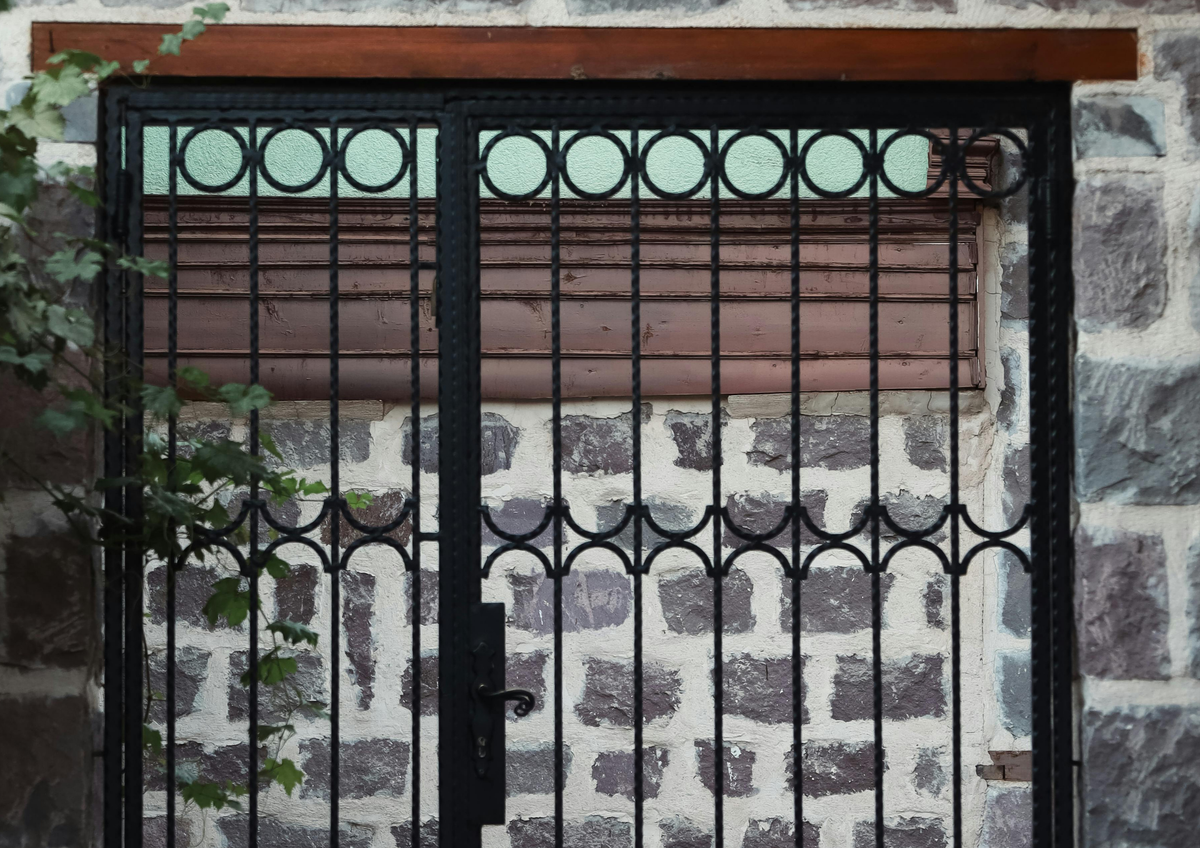
Search for fireproof fencing and you will find products advertised that way. The word has no basis in any material standard. The honest question is narrower: which fences will not catch fire, which ones carry flame to something that matters, and what does fire resistant fencing actually buy you on a tight Chicago lot? A fence is rarely what anyone is trying to protect. It is what either stops a fire from reaching a garage, a porch, or a neighbor's siding, or quietly delivers it there.
Short answer: No fence is fireproof. The useful category is noncombustible, which means the material will not ignite and will not add fuel to a fire. Steel, wrought iron, aluminum, and masonry are noncombustible. Wood, vinyl, and composite are not, and all three can carry fire across a property line. A noncombustible fence will not stop a structure fire on its own, but it removes the fence itself as a fuel path.
"Fireproof" Is Marketing. "Noncombustible" Is a Real Classification.
Codes do not recognize fireproof as a material property. They recognize two ideas that product copy blurs together.
Noncombustible describes a material that will not ignite and will not contribute fuel to a fire. Steel, iron, aluminum, concrete, and masonry fall here. They are not immune to fire. They can soften, warp, discolor, and lose their coating. But they do not burn and they do not feed a fire that is already going.
Fire-resistance rated describes an assembly, not a material, and it is always expressed in time. A one-hour rated wall was tested as a complete assembly and held back fire and heat for an hour. Ratings apply to walls, floors, doors, and partitions separating occupied spaces. Fences are not rated assemblies, because a fence is not an enclosure and nobody tests one. So a fence advertised as fireproof is, at best, claiming to be noncombustible, which is a real property but not a fire rating.
How Common Fence Materials Behave When Fire Reaches Them
Wood. A continuous line of dry fuel, usually running right against a garage, a gangway, or a neighbor's wall. Pressure treatment protects against rot and insects, not fire. Fire-retardant treated wood does slow ignition, but exterior treatments weather.
Vinyl. The one most people get wrong. It is sold as low maintenance, which readers hear as inert. Vinyl is a thermoplastic and does not need flame contact to fail. Radiant heat from a grill placed too close or a trash fire in an alley will soften and deform it, and at higher temperatures it ignites, drips, and produces dense acrid smoke.
Composite. Wood fiber bound in plastic. Slower to burn than solid wood and still combustible. It also melts, so it can fail structurally before it ignites.
Aluminum. Noncombustible and will never carry flame. It melts at a far lower temperature than steel, so under sustained direct fire it can sag or come down where a steel fence stays standing.
Steel and wrought iron. Noncombustible, high melting point, open pickets with nothing for fire to grab. An iron fence contributes no fuel and is usually still standing and serviceable after a fire that destroys everything around it.
Masonry. Best on fire alone, but heavy, expensive, and vulnerable to frost heave if the footing is wrong. Most Chicago lots end up with iron on a masonry base instead.
Why Fire Resistant Fencing Matters More on Chicago Lots
Chicago's residential grid was not built with separation in mind. Standard lots are 25 feet wide. Gangways between buildings are often three or four feet. Alley garages sit on the property line with frame construction on both sides. In that geometry a combustible fence is not a minor detail, it is a wick.
The realistic sequence looks like this. Something ignites in an alley or a yard: a trash container, a grill, a car, a garage. A wood or vinyl fence running from that point to the building picks it up and carries it. The fence delivers flame to a wood back porch or to siding, and from there the fire is inside a structure. The fence did not start anything and it is not what burned down, but it is what connected the two.
Interrupting that path is the entire practical value of fire resistant fencing in a dense neighborhood, which is why mixed runs are a problem. Iron across the front with wood down the side and along the alley leaves a continuous fuel path exactly where fires in this city start. Combustible add-ons do the same thing: wood gates in an iron run, trellises bolted to a metal fence, privacy slats woven through chain link.
What Steel and Iron Fencing Can and Cannot Do
Steel and iron contribute zero fuel, stop flame spread along their own length, stay standing through temperatures that destroy everything combustible nearby, and almost always remain repairable rather than replaceable afterward.
What they do not do is block radiant heat. An open picket fence is mostly air, and heat from a fully involved garage will pass straight through it and ignite siding on the other side. Only a solid mass wall slows radiant heat meaningfully. A noncombustible fence removes one fuel path. It is not a firebreak.
Fire also damages the finish long before it damages the metal, and bare steel in a Chicago winter starts corroding within weeks. That makes the post-fire inspection specific: bowed or twisted rails, panels no longer square, cracked welds at the joints, loose base plates where anchors took heat, and coating that has burned away. Sound panels get re-prepped and refinished through metal fence painting, while warped sections and failed welds get cut out and rebuilt. Full replacement is rare, but the coating has to be restored before the next freeze. The same check applies to any load-bearing steel the fire touched, including railings, stairs, fire escapes, and structural steel.
Gates and Hardware: The Part Everyone Forgets
Gates are where a fire plan quietly falls apart, and it is rarely about the gate material. If a gate is too narrow for a crew carrying equipment, or padlocked and chained, access is delayed exactly when delay costs the most. The fix is not complicated: a gate wide enough to be useful, hinged to swing clear, and a latch that releases without a key from the yard side.
Hardware is the other half. Latches, hinges, and closers seize after heat exposure, so a gate can look fine after a fire and still not open, and automated gates need a manual release that works with no power. Test a heat-exposed gate rather than assume, and have the frame and hardware checked through iron gate repair.
How to Specify a Fence That Will Not Carry Fire
Keep the whole run noncombustible. Partial coverage is close to no coverage. The fuel path is only broken if it is broken everywhere, gates and alley sections included.
Keep combustible attachments off it. No wood privacy slats, trellises, bamboo or reed screening, or plastic mesh. These negate the material choice entirely.
Prioritize the alley line and the gangway. That is where fires start and where buildings sit closest together. If the budget only covers part of the property, cover those.
Decide which problem the design solves. Open pickets give fire nothing to catch and let crews see through. Solid panels give more privacy and block more radiant heat.
Specify the coating for durability, not just color. A hot-dip galvanized base under the finish means fire damage to the coating is cosmetic rather than the start of corrosion.
Keep vegetation and storage off the fence line. Dry brush or stacked pallets against a noncombustible fence puts the fuel right back.
Fit the opening rather than forcing a stock panel. Stock sizes rarely suit a Chicago lot, and the leftover gaps are where combustible infill gets added later. Custom ironwork avoids that.
Key Takeaways
No fence is fireproof. The real classification is noncombustible, meaning the material will not ignite or add fuel.
Wood, vinyl, and composite all burn or melt. Vinyl can fail from radiant heat alone, with no flame contact.
Steel and wrought iron contribute no fuel and stay standing. Aluminum will not burn but softens at a far lower temperature.
On 25-foot Chicago lots, a combustible fence functions as a fuel path from the alley or yard to the building.
Fire usually destroys the coating before it damages the metal, so refinishing matters more than replacement.
Gate width, keyless release from inside, and a manual override on automated gates determine whether crews get in.
Frequently Asked Questions
Is there any such thing as a fireproof fence?
No. Fireproof is not a recognized material classification and no fence is tested or certified as fireproof. Products advertised that way are almost always noncombustible metal or masonry, which is a genuine advantage but a different claim. Noncombustible means the material will not ignite or feed a fire. It does not mean the fence is unaffected by one.
Will a metal fence stop a fire from spreading to my house?
Not by itself. It stops flame from traveling along the fence, which matters where a wood fence would have carried fire to a wall or a porch. But an open picket fence does not block radiant heat, and heat from a fully involved garage or vehicle can ignite siding straight through it. Treat it as removing one fuel path rather than as protection for the structure.
Can an iron fence be repaired after a fire or does it need replacing?
Usually repaired. The metal normally survives while the coating does not, so most fences come out of a fire needing panels re-prepped and refinished rather than rebuilt. Sections that took sustained direct flame can warp or crack at the welds, and those get cut out and replaced individually.
Does Chicago require noncombustible fencing anywhere?
The Chicago Construction Codes restrict combustible construction in specific situations, generally tied to proximity to lot lines and to building type and occupancy, and fences on commercial and multifamily properties can be affected. Residential fence rules are mostly about height, location, and permits rather than combustibility. Because it depends on the property, confirm with the Department of Buildings or have your fabricator check before finalizing a design.
Specifying Fire Resistant Fencing for a Chicago Property
The useful question is not which fence is fireproof, because none are. It is whether your fence line will carry fire to something that matters. Replacing combustible runs along the alley and the gangway with steel or iron removes that path, and doing it as part of a fence you were replacing anyway costs little extra. If you are weighing options for fire resistant fencing, or you have ironwork that took heat and needs assessing before winter, Americana Iron Works fabricates and installs custom steel and wrought iron fencing, gates, and railings across Chicago.