
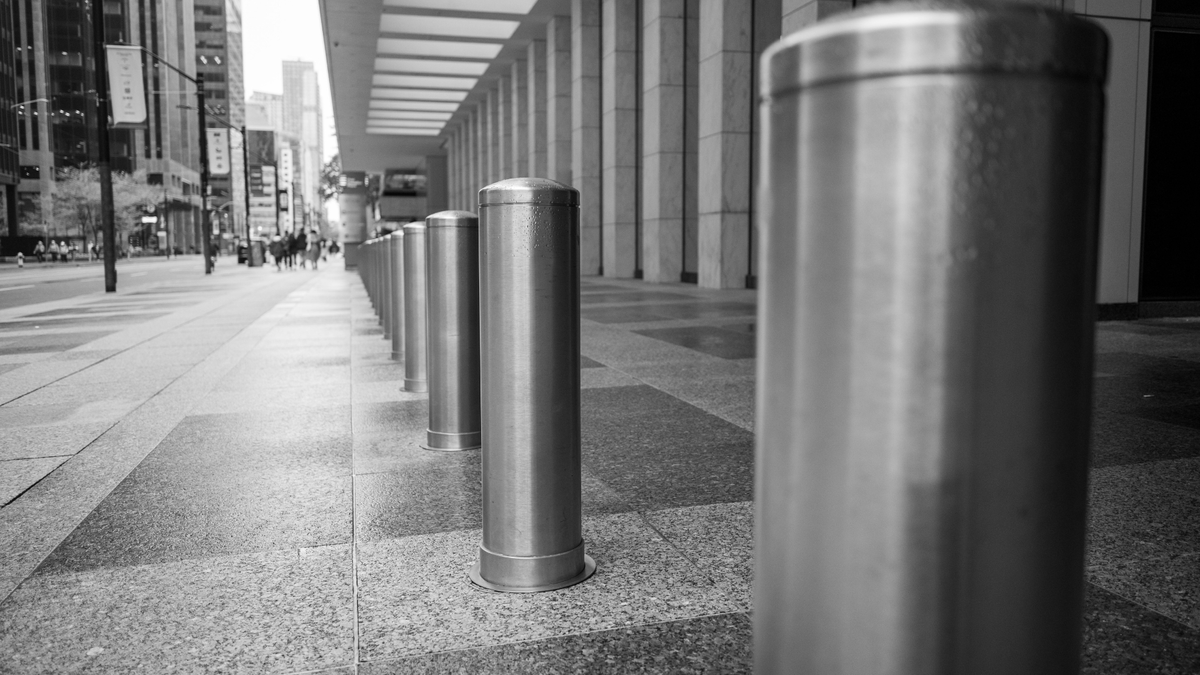
A bollard that looks correct and a bollard that stops a vehicle are frequently two different objects. Iron bollards installation in Chicago fails most often below grade, where nobody can inspect it, because the pipe above the sidewalk is the visible part and the footing is what actually does the work. A storefront owner comparing quotes sees similar posts and similar prices, and the difference is buried in concrete.
Placement, embedment depth, and anchoring method determine whether a bollard redirects a vehicle or simply bends over with it. Each is worth understanding before commissioning custom ironworks for a storefront.
SHORT ANSWER
An embedded bollard set in a concrete footing offers real vehicle resistance. A surface-mounted bollard bolted to a slab generally does not, and serves as visual guidance instead. In Chicago, footings must extend below the local frost depth, commonly cited at forty two inches, and the footing diameter matters as much as the depth. Space bollards close enough that a vehicle cannot pass between them while leaving at least thirty six inches of clear pedestrian width for accessibility.
What Bollards Actually Do
Bollards serve three distinct purposes, and confusing them produces the wrong installation.
Protection. Physically stopping or redirecting a vehicle before it reaches glass, a storefront wall, a gas meter, or a pedestrian area.
Guidance. Directing traffic flow, marking a boundary, or discouraging drivers from cutting across a corner.
Access control. Blocking a drive aisle or service entrance, usually with removable or retractable units.
Only the first requires engineered resistance. A guidance bollard can be surface mounted and decorative. A protective bollard installed the same way provides the appearance of safety without the substance, which is worse than none at all, because it influences where people stand.
Placement: Spacing and Setback
Two dimensions govern layout, and they pull against each other.
Spacing has to be tight enough that a vehicle cannot fit between adjacent bollards. Typical storefront layouts land in the range of four to five feet on center, measured to prevent passage rather than to look evenly distributed.
Clear width works in the opposite direction. Accessibility requirements call for a minimum clear passage along a pedestrian route, generally thirty six inches, and bollard layout cannot narrow the sidewalk below that. On a narrow Chicago sidewalk, those two requirements can conflict, and the resolution usually involves adjusting the line of bollards rather than the spacing between them.
Setback from the thing being protected matters as much as either. A bollard installed directly against a storefront window transfers impact energy into the building. Placing it far enough forward gives the bollard room to deflect a vehicle and absorb energy before anything behind it is involved.
Depth: Why Chicago Footings Go Deeper
Embedment depth is where most of the performance lives. A common design approach sets the below-grade portion at roughly a third of the bollard's total length, though the governing factor in Chicago is frost.
Chicago's frost depth requirement for footings is commonly cited at forty two inches. A footing that stops short of it will heave through winter freeze and thaw cycles, and a heaved bollard loses both its alignment and much of its resistance. That figure is a floor rather than a target, and impact resistance frequently calls for going deeper.
Footing diameter is the specification most often shortchanged. Resistance comes from the mass of concrete and the soil it bears against, not from the pipe alone. A narrow core drilled just wide enough to accept the post produces a bollard that will rotate in the ground under load. Guidance commonly calls for a footing several times the diameter of the bollard itself.
Two further details separate durable installations from ones that fail early. The pipe should be filled with concrete rather than left hollow, which substantially increases its resistance to deformation. And the top should be crowned or capped so water sheds rather than standing inside the post, since a bollard that holds water corrodes from the inside.
Anchoring: Embedded Versus Surface Mounted
The choice between these two is the single most consequential decision in the project.
Embedded bollards are set into a poured concrete footing. The load path runs from the pipe into the footing into the surrounding soil, which is why they resist meaningful impact.
Surface-mounted bollards attach to an existing slab through a baseplate and anchor bolts. Installation is faster and far less disruptive, and the resistance depends entirely on the slab. A four inch sidewalk slab will fail at the anchors well before the post does. These are appropriate where the goal is guidance or where excavation is genuinely impossible, and inappropriate where vehicle protection is the objective.
Removable and retractable bollards use a permanent sleeve set in concrete with a post that lifts out or lowers. They solve access problems for delivery lanes and fire lanes, and the sleeve still requires a proper footing.
Where impact resistance must be documented rather than assumed, crash-rated bollards tested to recognized standards are the category to specify. Those are engineered assemblies with defined foundation requirements, and substituting a similar-looking pipe does not carry the rating.
Iron Bollards Installation: What to Check Before Digging
Excavation on a Chicago sidewalk carries complications a suburban parking lot does not.
Locate utilities. Illinois requires notification before excavation, and the statewide locating service exists for exactly this. Gas, electric, and communication lines run shallow near storefronts.
Check for sidewalk vaults. Many older Chicago buildings have vaulted space extending under the public sidewalk. Drilling a footing into a vault ceiling is both a structural and a safety problem, and the vault will not appear on a utility locate.
Confirm property line and public way status. Work in the public right-of-way is permitted differently than work on private property, and installing in the public way without authorization can result in removal at the owner's expense.
Verify the surface below. Parking structures, basements, and below-grade loading areas all limit how deep a footing can go and may rule out embedded bollards entirely.
Confirm permit requirements. Scope, location, and whether the work touches the public way all affect what is required, so verify with the city rather than assuming.
Materials, Fabrication, and Finish
Standard practice uses steel pipe, with wall thickness selected for the intended resistance. Heavier wall pipe deforms less under impact, and diameter affects both resistance and visibility.
Custom fabrication becomes relevant when a storefront needs bollards that match existing ironwork, incorporate a decorative profile, or integrate with railings and fencing. Fabricated structural steel work allows the protective function and the storefront appearance to be resolved together rather than traded against each other.
Finish is not cosmetic in this application. The grade line, where the post meets concrete or soil, is where corrosion concentrates, because water and road salt collect there through Chicago winters. Galvanizing, powder coating, or a properly prepared industrial paint system all extend service life considerably, and periodic attention through metal painting keeps the protection intact. Sleeves in polymer or stainless can cover a steel post for appearance, though they contribute nothing structurally.
Bollards as Part of a Perimeter
Bollards rarely work alone. A storefront exposed at the front but open along a service alley has moved the problem rather than solved it. Reviewing the full perimeter, including where vehicles approach, where they park, and where the property boundary sits, produces a coherent plan. In many cases the answer combines bollards at the vulnerable frontage with iron fencing or gates elsewhere on the property.
Key Takeaways
Embedded bollards in a concrete footing resist vehicle impact, while surface-mounted units generally provide guidance only.
Footings must extend below Chicago's frost depth, commonly cited at forty two inches, and deeper where impact resistance is the goal.
Footing diameter drives resistance as much as depth, so a narrow core drill undermines the installation.
Space bollards to prevent vehicle passage while preserving at least thirty six inches of clear pedestrian width.
Fill the pipe with concrete and cap or crown the top so water does not stand inside.
Check for sidewalk vaults and confirm public way status before any excavation downtown.
Protect the grade line with an appropriate coating, since that is where corrosion begins.
Frequently Asked Questions
How deep should a bollard footing be in Chicago?
Below the local frost depth at minimum, commonly cited at forty two inches, with greater depth where the bollard is intended to resist vehicle impact. Footing diameter should be specified alongside depth, since a deep but narrow footing still allows the post to rotate under load.
Can bollards be installed without digging?
Surface-mounted bollards anchor to an existing slab and require no excavation, but their resistance is limited by the slab thickness and anchor capacity. They suit guidance and boundary marking rather than vehicle protection.
How far apart should storefront bollards be?
Close enough that a vehicle cannot pass between them, typically four to five feet on center, while maintaining the clear pedestrian width required for accessibility. Narrow sidewalks may require adjusting the line rather than the spacing.
Do I need a permit for bollards in Chicago?
It depends on location and scope, and particularly on whether the installation sits on private property or in the public way. Confirm requirements with the city before work begins, since unauthorized installation in the public right-of-way can result in required removal.
Will bollards stop a vehicle completely?
That depends on the bollard, the footing, and the speed and mass of the vehicle. Properly embedded bollards resist or redirect typical parking lot impacts. Where documented performance is required, crash-rated units tested to recognized standards are the appropriate specification.
How long do iron bollards last in Chicago weather?
Service life depends almost entirely on the finish and on drainage at the grade line. A well-coated bollard that sheds water lasts many years, while one holding water inside the pipe or with a failed coating at grade corrodes considerably faster.
Conclusion
Iron bollards installation in Chicago rewards attention to the parts that disappear once the concrete cures. Depth below the frost line, adequate footing diameter, spacing that accounts for both vehicles and pedestrians, and a coating that survives at the grade line separate a bollard that protects a storefront from one that decorates it.
Americana Iron Works & Fence fabricates and installs bollards, barriers, iron fencing, gates, and custom structural ironwork for commercial properties throughout Chicago and the surrounding suburbs, with more than thirty years of work on city sidewalks and storefronts. If your storefront is exposed to vehicle traffic or your existing bollards are corroding at the base, reach out today to request a free quote.