
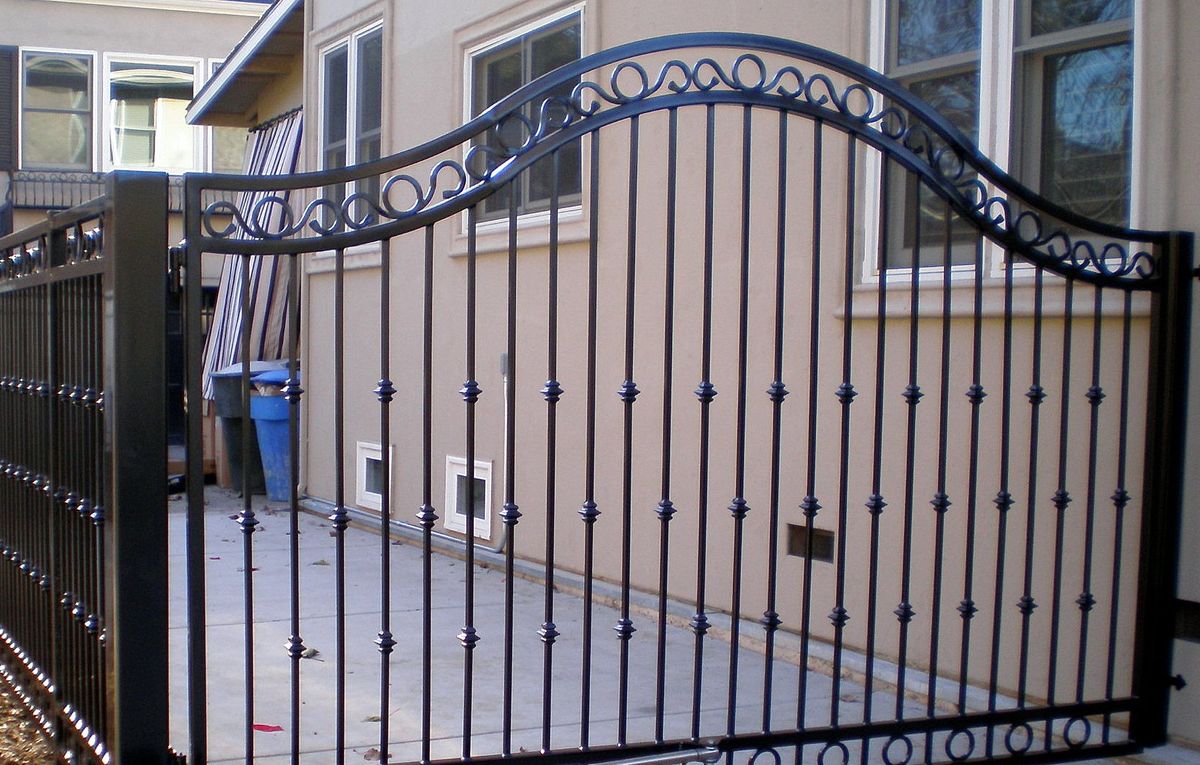
Steel vs Wrought Iron Fencing: Which Lasts Longer in Chicago
Steel vs wrought iron fencing is the comparison most Chicago homeowners think they are making, and in nearly every case it is not the comparison in front of them. Both quotes are usually for the same metal. What separates a fence that lasts thirty years from one that fails in eight is not the name on the invoice.
Short answer: True wrought iron has not been produced commercially since the early 1970s, and the last American plant closed in 1969. Anything sold today as a wrought iron fence is mild steel, named for the style rather than the material. So the real question is not which metal lasts longer but how the steel is protected, and there the answer is clear: hot-dip galvanized steel under a finish coat outlasts bare or painted steel by a wide margin. Genuine antique wrought iron cannot be hot-dip galvanized at all, which means a properly specified new steel fence will likely outlive it outdoors.
What You Are Actually Being Quoted
The last wrought iron plant in the United States closed in 1969. The last in the world, in Bolton, England, closed in the early 1970s. Wrought iron is no longer made on a commercial scale anywhere.
Despite that, the fencing and gate trade still uses the term, and does so almost universally. Gates, guard rails and ornamental fencing described as wrought iron are mild steel, called wrought iron because they resemble objects that were once worked by hand. The word now describes an appearance, not a metallurgy.
This is not a deception so much as an industry convention, but it has a practical consequence. If you are weighing a "steel" quote against a "wrought iron" quote, you are probably comparing two mild steel fences, and the differences between them lie in section sizes, fabrication quality and coating. Asking what the material actually is, and how it is finished, gets you further than asking which of the two names is better.
Steel vs Wrought Iron Fencing: The Real Material Difference
Where genuine wrought iron does exist, usually in historic fencing, railings and gates predating the 1970s, the difference from mild steel is real.
Wrought iron is very low in carbon and contains slag worked into the metal, up to roughly two percent by weight, distributed as something on the order of 250,000 inclusions per square inch. Those inclusions give it a fibrous, grain-like internal structure. It is the reason old wrought iron can be worked, split and reformed by a blacksmith in ways mild steel will not tolerate.
Mild steel is a more uniform material with higher carbon and without those inclusions. It is stronger in tension, more consistent from batch to batch, easier to weld, and vastly cheaper to produce, which is why it replaced wrought iron entirely rather than partially.
For fencing, the fibrous structure matters less than the corrosion behavior it produces, which is where the lifespan question actually lives.
How Each One Corrodes
The common claim is that wrought iron resists rust better than steel. The accurate version is more qualified and more useful.
Wrought iron's corrosion resistance varies with the ore it came from and how it was made, and depending on both it can be either better or worse than other iron alloys. Where it does perform better, the mechanism is specific: siliceous impurities in the slag, mainly ferrous silicate, cause corrosion to spread into a relatively even film rather than concentrating in one spot. The benefit is resistance to pitting, not immunity to rust.
That distinction matters because pitting is the corrosion that actually takes a fence out of service. A section losing thickness evenly across its surface stays predictable. A section with a deep pit can perforate while the metal around it still looks sound.
Mild steel has no such mechanism. Left bare in a Chicago winter, with chloride from de-icing salt driving localized attack, it pits. Which is why the comparison turns on protection rather than on the base metal.
The Galvanizing Problem
Here is the fact that settles the lifespan question, and it runs opposite to what most people expect.
Mild steel can be hot-dip galvanized. Wrought iron cannot. Galvanizing is the most effective corrosion protection available for exterior fencing, because the zinc bonds metallurgically to the steel and protects it sacrificially, including at scratches and cut edges where paint offers nothing.
So the modern material can receive the best available protection and the historic one cannot. A galvanized steel fence with a finish coat over it will, under Chicago conditions, very likely outlast genuine wrought iron left to its own devices. The older material's advantage in corrosion behavior is real but modest, and it is outweighed by a protection system it is not compatible with.
What Actually Determines Service Life in Chicago
Ranked by how much each one moves the number.
1. The coating system. By a wide margin the most important variable. Galvanized under a finish coat is the durable specification. Powder coat or paint applied directly over bare steel is not, however good it looks on delivery. The coating approach is worth more scrutiny than the metal itself.
2. Drainage and detailing. Hollow sections that cannot drain, unsealed cut ends, and tight joints that hold water will fail early regardless of material or coating. Water that cannot leave is the problem.
3. The base condition. Where the fence meets grade or concrete takes the most exposure, holds debris and salt, and dries last.
4. Section thickness. Heavier sections have more material to lose before capacity is affected. Two fences with the same coating and different wall thickness do not age the same.
5. Maintenance. Recoating on schedule, before coating failure becomes metal loss, extends service life more cheaply than any material upgrade.
Notice that four of the five have nothing to do with choosing between steel and wrought iron. That is the real answer to the lifespan question.
When You Do Have Real Wrought Iron
Plenty of Chicago properties have genuine wrought iron, particularly in older neighborhoods with original fencing, gates and railings. For those, the calculation is different.
It is not replaceable in kind, because the material is not made anymore. That makes an original wrought iron fence worth repairing rather than replacing where it is structurally sound, and worth having assessed by someone who can tell the difference rather than assuming. Repair of historic ironwork is feasible, and the fibrous structure that makes the material distinctive is also what allows a skilled fabricator to work with it.
Where sections are beyond saving, the practical route is matching the profile in steel, which is custom fabrication rather than an off-the-shelf purchase. Visually the match can be very close. Metallurgically it is a different fence, which is fine as long as it is a decision rather than a surprise.
Key Takeaways
True wrought iron has not been commercially produced since the early 1970s. The last US plant closed in 1969.
Fencing sold today as wrought iron is mild steel. The term now describes a style, not a material.
Genuine wrought iron contains up to roughly two percent slag, around 250,000 inclusions per square inch, giving it a fibrous structure.
Wrought iron's corrosion resistance varies by ore and manufacture and can be better or worse than other alloys. Where better, it resists pitting rather than resisting rust outright.
Mild steel can be hot-dip galvanized. Wrought iron cannot, which is the decisive practical difference.
Galvanized steel under a finish coat will likely outlast unprotected genuine wrought iron in Chicago conditions.
Coating, drainage, base condition, section thickness and maintenance decide service life. Four of those five are unrelated to the steel versus wrought iron question.
Frequently Asked Questions
Is my existing fence real wrought iron?
If it was installed after about 1970, almost certainly not. Older fencing may well be. Genuine wrought iron often shows a fibrous or grained texture where it has corroded or been cut, and hand-worked details rather than uniform machine-made ones. An assessment on site is more reliable than any visual test from a photo, and it matters because it changes whether repair or replacement is the better call.
So is steel or wrought iron better for a new fence?
The question does not really apply to new work, because new fencing is steel either way. What to compare instead is the coating specification, the section sizes, and how cut ends and hollow sections are sealed and drained. A galvanized fence with heavier sections from one fabricator will outlast a lighter painted one from another, whatever either quote calls the material.
Does galvanizing really make that much difference?
Yes, and more than any other single choice. Zinc bonds to the steel and protects it sacrificially, so a scratch or a drilled hole does not become a corrosion site the way it does under paint alone. Paint over bare steel protects only where it remains intact, which in a Chicago winter is not indefinitely.
Can wrought iron be galvanized if I want it protected?
Hot-dip galvanizing is not applicable to wrought iron. Historic ironwork is protected by sound surface preparation and a quality coating system maintained on schedule, which means recoating is a recurring commitment rather than a one-time treatment. On pre-1978 ironwork the preparation also runs into lead paint rules, which restrict the permitted methods.
What about aluminum instead?
Aluminum does not rust, which makes it attractive in a salt environment, and aluminum fencing suits plenty of residential applications. The tradeoff is strength: it is a softer, lighter material, so it is a weaker choice for security, for tall runs and anywhere impact is likely. It is a different fence rather than a drop-in substitute for steel.
Choosing Between Steel vs Wrought Iron Fencing
The honest summary on steel vs wrought iron fencing is that the choice is mostly already made for you. New fencing is steel, the wrought iron label describes a look, and the variables that decide whether a fence lasts a decade or three are coating, detailing and upkeep. If you have real wrought iron, that is a repair and preservation question rather than a shopping one.
Americana Iron Works fabricates, installs and repairs iron fencing and wrought iron style fencing across Chicago, and handles fence repair on existing runs including historic ironwork worth keeping. Ask about the coating specification when you request a quote, since that is the line item that determines how long the fence lasts.